We tested ChatGPT Ads with our own money. Here's what we learned about traffic quality, targeting, lead generation and whether they're worth it.
When ChatGPT introduced advertising in 2026, it created a new question for businesses already navigating an increasingly complicated digital marketing landscape: Is ChatGPT Ads worth investing in?
The potential is interesting. Instead of reaching people through search keywords or social media feeds, advertisers have an opportunity to reach audiences within a conversational platform where people are actively researching problems, comparing options, and exploring ideas.
But potential doesn't necessarily translate into results.
At Bishop & Royal, we decided to test the platform ourselves rather than rely on predictions about what it might become. We created campaigns for our own consulting business, spent our own money, configured tracking, and analyzed the results in Google Analytics 4 (GA4).
Our initial test generated nearly 15,000 impressions, 112 clicks, and website visitors who were more engaged than those arriving through several of our established traffic sources.
It also generated zero qualified leads and zero booked consultations.
That contrast is what makes the results worth examining.
Here's what we spent, what we learned, where ChatGPT Ads fell short, and how we'd approach testing the platform differently today.
We tested ChatGPT Ads to promote Bishop & Royal's business consulting and growth services, including strategy, marketing, analytics, and website development.
Our goal was straightforward: determine whether the platform could introduce our services to relevant businesses and generate qualified inquiries.
Here are the results from our initial campaign:
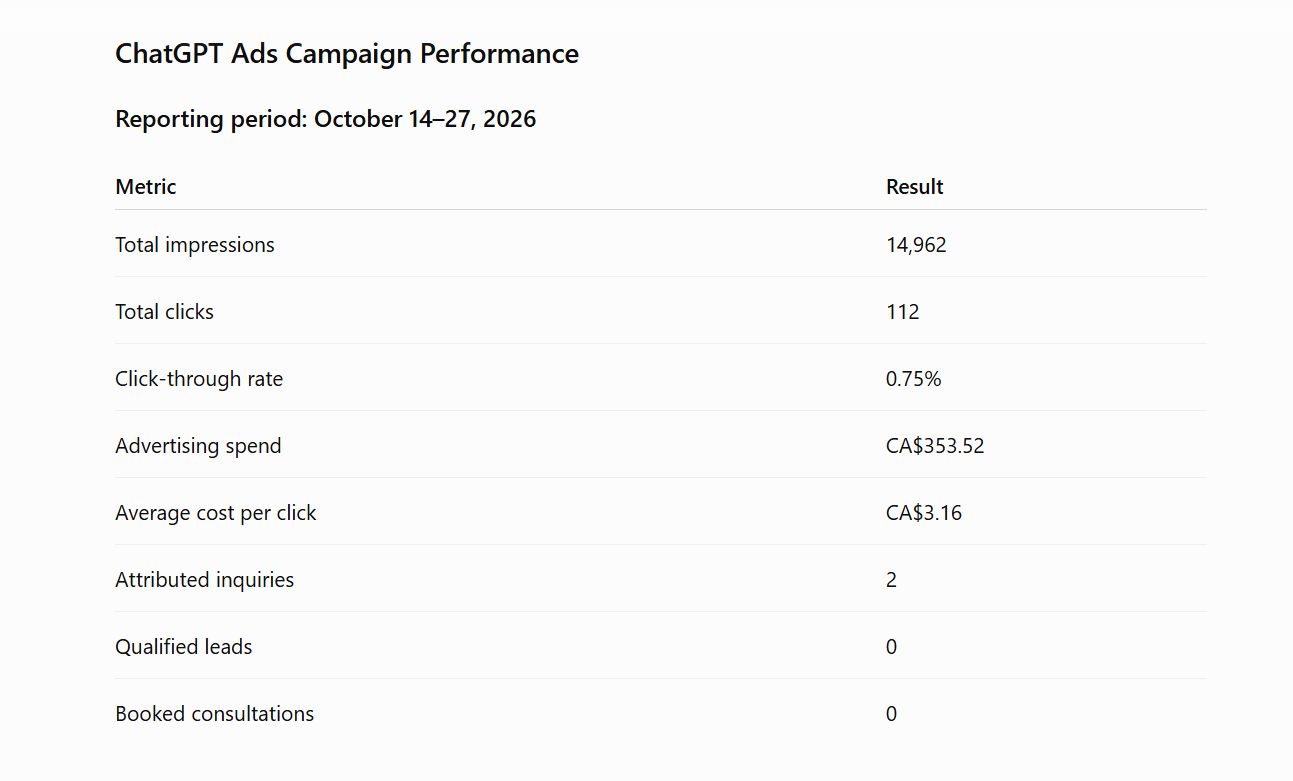
At first glance, the traffic costs weren't particularly surprising. A CPC of approximately $3.16 can be perfectly reasonable for business-to-business advertising, depending on the audience, service, and value of a new client.
The problem wasn't necessarily what we paid for each click.
The problem was what those clicks produced.
We spent $353.52 and received two inquiries, neither of which developed into an actionable sales opportunity.
For a campaign intended to generate new business, that's not a successful outcome.
However, the website analytics told a more interesting story.
One of the most unexpected results came from GA4.
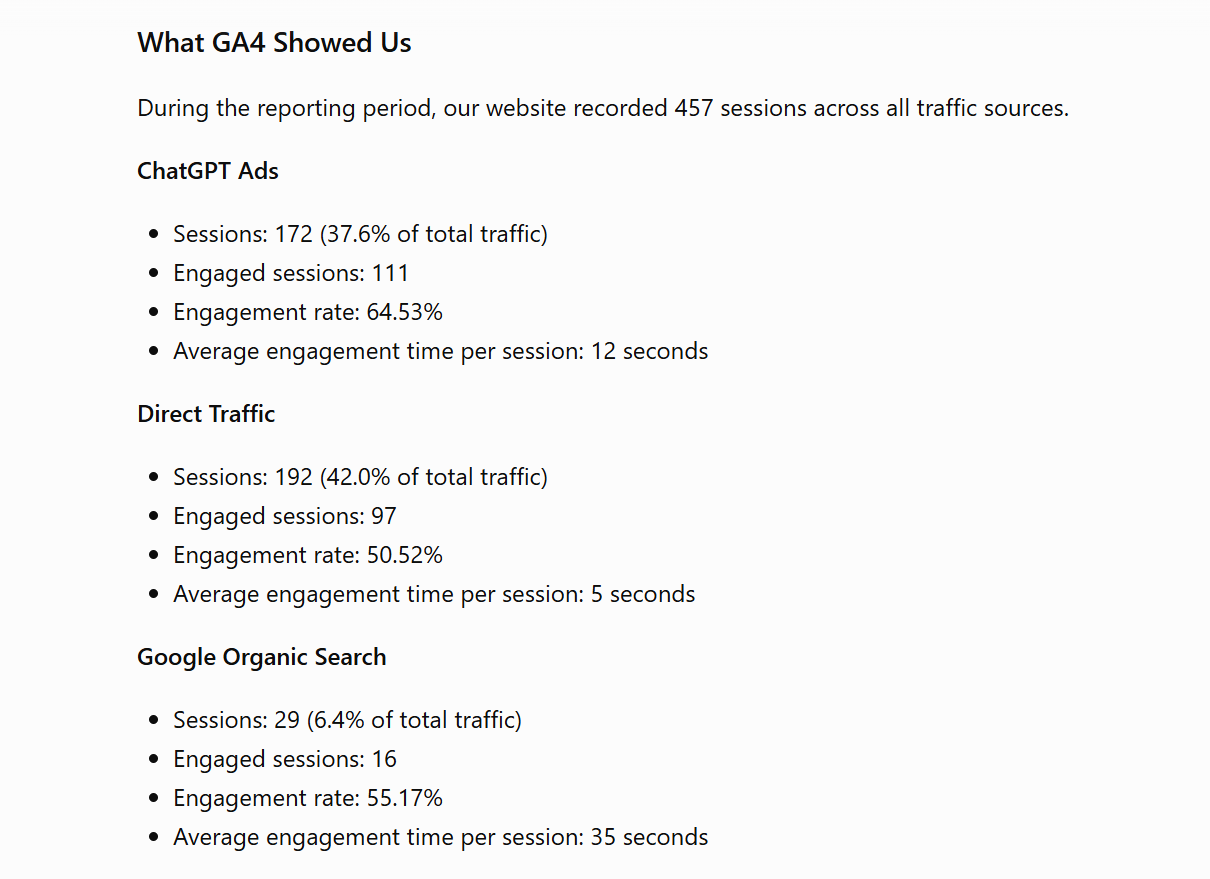
During the measurement period, traffic attributed to chatgpt/paid became our second-largest source of website traffic, accounting for approximately 38% of sessions.
It was nearly tied with direct traffic.
Even more interesting was how those visitors behaved once they arrived.
Visitors arriving through ChatGPT Ads had a higher engagement rate than those arriving through Google organic search or direct traffic during the same period.
That's a meaningful observation, particularly for an unfamiliar advertising channel.
But it's important to understand what GA4 engagement actually measures.
An engaged session in GA4 generally involves a visitor staying on the website for more than 10 seconds, triggering a key event, or viewing at least two pages or screens.
It does not necessarily mean someone is interested in purchasing a service.
A visitor could spend several minutes reading about our business, exploring our website, or researching our services without having any intention of becoming a client.
And that's precisely the distinction our results highlighted.
Engagement measures interaction. It doesn't establish commercial intent.
For us, ChatGPT Ads succeeded at attracting visitors who interacted with our website. What it didn't demonstrate was an ability to consistently attract people ready to engage Bishop & Royal.
The campaign generated two inquiries that we could attribute directly to ChatGPT Ads.
The first came from someone offering psychic services. Their inquiry was unrelated to the business consulting services we were advertising.
The second appeared more promising initially. It came from someone identifying themselves as a chiropractor, a type of business we have experience working with.
Unfortunately, the contact information provided was inaccurate, making it impossible to follow up or verify whether the inquiry represented a genuine business opportunity.
That left us with:
These are two different lead-quality problems.
The first inquiry was unrelated to the service being advertised. The second was potentially relevant, but the information submitted made the lead unusable.
Neither produced a viable sales opportunity.
This is why we distinguish between inquiries, qualified leads, and actual business outcomes when evaluating marketing performance.
A platform can generate form submissions without generating customers.
If we'd judged the campaign solely on clicks, engagement, or the number of inquiries, we would have missed the most important finding.
Our advertising generated activity, but it didn't generate business.
Beyond lead quality, our test revealed several limitations and unanswered questions about how the platform was delivering traffic.
One of the defining differences between ChatGPT Ads and traditional search advertising is the role of conversational context.
With Google Search Ads, advertisers can use search-term reporting to better understand what people were looking for when their ads appeared.
During our ChatGPT Ads test, we didn't have equivalent visibility into the specific conversations or questions associated with our placements.
We could see impressions and clicks, but we couldn't determine which types of conversations were generating them.
For a business offering several different services, that's a significant limitation.
Was someone researching business strategy? Comparing marketing agencies? Looking for analytics help? Exploring website development?
We couldn't tell.
And without that context, it was difficult to determine whether poor lead quality reflected the audience, the creative, the offer, or the way our advertisements were being matched to conversations.
We could improve our ads and landing pages, but we couldn't directly inspect the conversational context behind the traffic.
We configured our campaign to target Ontario.
GA4 showed traffic from relevant Ontario locations, including Toronto, Mississauga, and Kitchener.
However, we also saw activity associated with locations well outside our intended market, including:
Some of these locations are associated with major data-centre infrastructure, and several of the sessions had little or no recorded engagement time.
That raised questions about how the traffic was being classified and whether some activity might have been automated or routed through infrastructure outside our target region.
However, there's an important distinction here.
A location appearing in GA4 doesn't necessarily prove an advertisement was delivered to someone physically located there.
Analytics geography can be affected by network routing, IP-based location estimates, privacy tools, and automated systems.
We therefore wouldn't conclude from these reports alone that ChatGPT's geographic targeting failed.
What we can say is that the analytics contained unexpected locations, and we didn't have enough information to confidently explain all of them.
For businesses relying on tightly defined local markets, that uncertainty is worth investigating.
ChatGPT Ads was still an emerging advertising platform when we ran our campaigns.
We encountered some rough edges in the campaign creation process, including inconsistent messaging around headline character limits and a narrower set of campaign objectives and targeting controls than we were accustomed to using in established advertising platforms.
At the time of our test, we were primarily working with click- and reach-oriented campaign objectives rather than the more developed conversion-focused workflows available through platforms like Google Ads and Meta.
The interface also placed limitations on how precisely we could investigate and refine campaign performance.
Advertising platforms evolve quickly, and some of these capabilities have since expanded. Our experience should therefore be understood as a snapshot of the platform during our initial testing, not a permanent description of everything ChatGPT Ads can do.
Still, it reinforced an important lesson: when testing a new channel, the maturity of its measurement and optimization tools matters almost as much as its audience reach.
One of the first things we did was configure our own tracking.
We used UTM parameters to identify advertising traffic in GA4 and monitored how those visitors behaved after arriving on our website.
This allowed us to compare ChatGPT Ads against other traffic sources and evaluate more than impressions and clicks.
We also configured conversion tracking to support campaign measurement.
Our GA4 reports showed no recorded key events for the paid ChatGPT traffic in the relevant report, despite two inquiries being attributed to the campaigns through our lead records.
That distinction matters.
A missing GA4 key event doesn't automatically mean no inquiry occurred. It can also reflect differences in attribution, event configuration, or measurement.
In our case, we could identify the two inquiries separately, but GA4 didn't provide a complete picture of those outcomes in the report we reviewed.
ChatGPT Ads now has documented conversion measurement capabilities, including its Pixel and Conversions API. Advertisers should evaluate those options alongside their existing analytics systems rather than assume that platform reporting alone will answer every performance question.
For us, the broader lesson was straightforward:
Don't evaluate a new advertising channel exclusively through its own dashboard.
A useful measurement setup should help answer several questions:
The last two questions are often the most important, and they're not always answered by advertising metrics alone.
One hypothesis emerged as we reviewed the campaign.
Bishop & Royal offers several interconnected services: business strategy, technical consulting, analytics, growth marketing, websites, and digital systems.
That breadth makes sense for our consulting model. We help organizations solve problems that often cross multiple business functions.
But it may not be the easiest proposition to communicate through a new contextual advertising channel.
Consider the difference between these two offers:
Broad offer: Business strategy, analytics, marketing, and digital transformation consulting.
Specific offer: Fix broken GA4 conversion tracking so your business can measure which campaigns generate leads.
The second offer identifies a much clearer problem, buyer, and desired outcome.
Our hypothesis is that a specific offer may make it easier to align advertising messaging, conversational relevance, and landing-page expectations.
That doesn't mean ChatGPT Ads necessarily performs better for narrow offers. We haven't conducted a controlled comparison that would establish that.
It does mean our initial results gave us a reason to reconsider how we structured our campaigns.
Rather than advertising the full breadth of Bishop & Royal's services, a future test could focus on one defined business problem.
For example:
Each could have its own creative, landing page, and conversion objective.
That would give us a clearer way to evaluate whether the problem was the channel itself or the way we presented our services.
Based on our initial experience, we wouldn't recommend ChatGPT Ads as an automatic addition to every marketing budget.
But we also wouldn't dismiss the platform because our first test didn't generate qualified leads.
There are situations where a measured experiment may make sense.
A business may be a reasonable candidate if it has a clearly defined offer, a relevant audience, and enough budget to experiment without depending on immediate results.
It also helps to have a dedicated landing page and reliable conversion tracking already in place.
For businesses introducing a new product, building awareness, or exploring an emerging acquisition channel, the ability to reach engaged audiences could be valuable.
However, that value needs to be evaluated against the actual objective.
If awareness is the goal, engagement and relevant reach may be useful measures.
If customer acquisition is the goal, qualified leads, sales opportunities, and revenue should carry considerably more weight.
We'd be more cautious about recommending ChatGPT Ads to businesses that:
Some regulated industries, including certain healthcare categories, have additional eligibility and advertising requirements. Businesses should verify current policies before planning a campaign.
The important question isn't simply whether ChatGPT Ads can deliver traffic.
It's whether the platform can deliver the right audience at a cost that makes sense for the business.
If we were planning a new campaign, we'd make several changes based on what we learned.
Rather than promote an entire business or service portfolio, we'd begin with a specific problem and a clear solution.
This would make the advertising message easier to evaluate and help us understand whether the platform was reaching the intended audience.
Our initial test reinforced the importance of connecting advertising messages to a specific next step.
A dedicated landing page would allow us to present a focused offer, explain its value, and give visitors one primary action to take.
It would also make the campaign easier to measure.
We wouldn't treat every form submission as a successful conversion.
Before launching, we'd establish what makes an inquiry relevant and actionable.
That could include business type, location, service need, contact information, and whether the person is actually looking to purchase the advertised service.
This would help us avoid confusing inquiry volume with meaningful demand.
A small test can provide useful directional information, but it rarely provides enough data for definitive conclusions.
We'd establish a budget, measurement period, and success criteria before launching.
We'd also decide what evidence would justify continuing, adjusting, or stopping the campaign.
That prevents an experiment from becoming an open-ended advertising expense.
A $3 click isn't inherently cheap or expensive.
Its value depends on what happens afterward.
We'd compare ChatGPT Ads against existing channels using metrics such as qualified lead cost, sales opportunity cost, and eventual customer acquisition cost where enough data exists.
That comparison would tell us much more than CPC alone.
Our initial ChatGPT Ads test produced mixed results.
On the positive side, the platform delivered nearly 15,000 impressions, 112 clicks, and visitors with a higher engagement rate than several of our established traffic sources.
It also provided an opportunity to test an emerging advertising environment firsthand.
But the commercial outcome was disappointing.
We spent CA$353.52, generated two attributed inquiries, and ended with no qualified leads or booked consultations.
We also encountered limitations around placement visibility, geographic analytics, and campaign controls that made it difficult to fully explain the results.
Would we test ChatGPT Ads again?
Yes, potentially. But we'd approach it differently, with a more specific offer, a dedicated landing page, stronger lead qualification, and clearly defined success criteria.
Would we recommend that every business start advertising on ChatGPT?
No.
Our test demonstrated that ChatGPT Ads could generate attention and website engagement. It didn't demonstrate that the channel could generate qualified demand for our particular offering.
And that's the distinction businesses need to understand.
New technology creates opportunities, but it doesn't eliminate the need for sound strategy, reliable measurement, and disciplined investment decisions.
At Bishop & Royal, that's how we approach growth: understanding what the data actually tells us, identifying what remains uncertain, and helping businesses invest where there's a credible opportunity for results.
If you're evaluating a new marketing channel, questioning the performance of your existing campaigns, or trying to connect marketing activity to business outcomes, let's talk.
Bishop & Royal is a Waterloo-based business and technology consulting firm helping organizations turn complex problems into a clearer path forward. Our work spans business strategy, analytics, marketing, digital systems, and implementation.


Waterloo, ON
Serving clients in Waterloo, Kitchener,
Cambridge, Guelph, and virtually across
Canada and beyond.